
Mako SmartRobotics™ — Connecticut
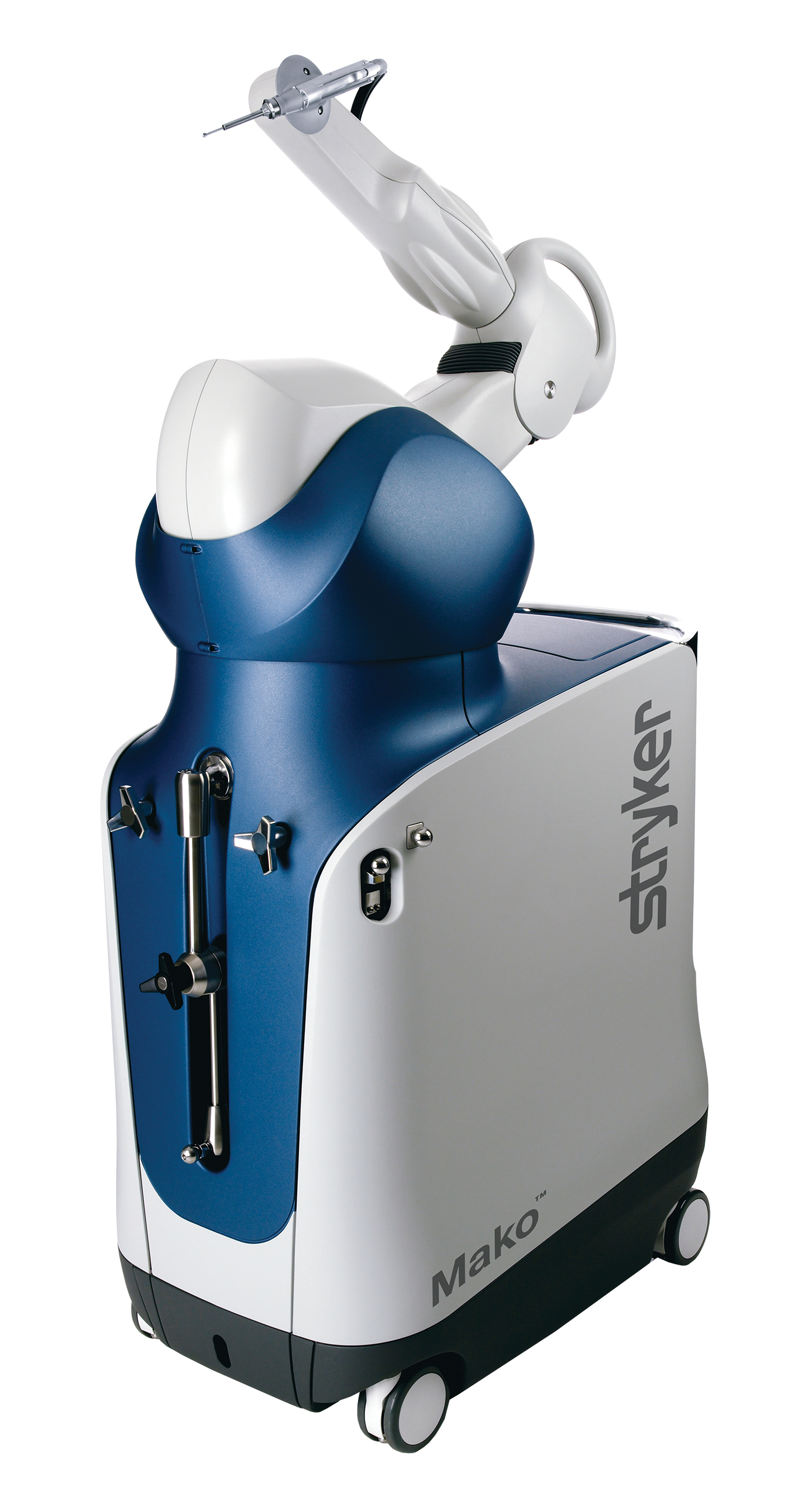
Mako Robotic Hip & Knee Replacement in Connecticut
Vipul Dua, MD brings Mako robotic-arm assisted technology to patients across Hartford County and Tolland County — delivering a personalized surgical plan based on your unique anatomy, with greater precision and faster recovery than traditional surgery.
- Board-Certified Orthopedic Surgeon
- Mako-Certified Specialist
- Hartford & Tolland County Patients
- South Windsor, CT Office
How Mako Robotic Surgery Works
Mako SmartRobotics™ is a three-stage process that combines advanced imaging, personalized planning, and real-time surgical guidance — all under the complete control of your surgeon.
Step 1: CT Scan & 3D Modeling
Before surgery, a CT scan of your hip or knee creates a highly accurate, three-dimensional model of your joint. This is the foundation of your personalized surgical plan — built around your specific anatomy, not a generic template.
Step 2: Pre-Operative Planning
Dr. Dua uses the 3D model to determine the precise size, orientation, and alignment of your implant before setting foot in the operating room. Potential issues are identified and addressed in advance, reducing surprises during surgery.
Step 3: Guided Surgery with AccuStop™
During the procedure, Dr. Dua controls the Mako robotic arm. AccuStop™ technology provides real-time tactile, visual, and auditory feedback — helping him stay precisely within the surgical plan, protecting healthy bone and soft tissue.
The Mako robotic arm does not operate independently. Dr. Dua is in complete control at every moment. The system is a precision tool — with the surgeon making every decision.
Mako Procedures Offered
Vipul Dua, MD performs three Mako procedures at facilities serving Hartford County and Tolland County, Connecticut.
Mako Total Knee Replacement
For patients with mid-to-late-stage osteoarthritis affecting the entire knee joint, Mako total knee replacement allows Dr. Dua to replace the damaged joint surfaces with a Triathlon® implant — precisely sized and aligned to your anatomy.
Clinical studies have shown that Mako total knee patients report less post-operative pain, shorter hospital stays, and faster return to daily activities compared to conventional knee replacement.
The robotic guidance helps achieve proper soft tissue balance — the key factor in how natural your knee feels after surgery.
You may be a candidate if you have:
- Mid-to-late-stage knee osteoarthritis
- Chronic knee pain not relieved by medication, therapy, or injections
- Knee stiffness that limits daily activities (walking, climbing stairs)
- Rheumatoid arthritis or post-traumatic arthritis of the knee
- Knee deformity (bow-legged or knock-kneed appearance)
Mako Partial Knee Replacement
When osteoarthritis has damaged only one compartment of the knee — most commonly the inner (medial) compartment — partial knee replacement may be a better option than replacing the entire joint.
Mako's 3D planning helps Dr. Dua selectively target the diseased portion while preserving the healthy bone, cartilage, and ligaments around it. This typically means a smaller incision, less blood loss, and a faster recovery than total knee replacement.
Partial knee replacement is only appropriate for specific anatomic situations. Dr. Dua will evaluate your imaging and symptoms to determine if you qualify.
You may be a candidate if you have:
- Early-to-mid-stage osteoarthritis in one compartment of the knee
- Knee pain localized to one side (inner or outer)
- Intact cruciate ligaments
- A healthy range of motion in the knee
- Not responded adequately to conservative treatments
Mako Total Hip Replacement
Hip replacement is one of the most common and successful surgeries in orthopedics — but precise implant positioning is critical for long-term function and longevity. Mako gives Dr. Dua the ability to plan your hip surgery to the millimeter.
Using your 3D CT model, Dr. Dua determines the ideal cup and stem position before surgery. During the procedure, the robotic arm guides cup placement to match that plan — helping achieve proper leg length, offset, and joint mechanics.
Clinical studies comparing Mako hip replacement to manual techniques show higher patient activity scores and improved outcomes at one-year follow-up.
You may be a candidate if you have:
- Hip osteoarthritis, rheumatoid arthritis, or post-traumatic arthritis
- Avascular necrosis (AVN) of the femoral head
- Hip dysplasia causing joint deterioration
- Chronic hip pain affecting sleep, walking, or daily function
- Pain not adequately controlled by non-surgical treatments
Benefits of Mako Robotic-Assisted Surgery
Mako's precision translates into meaningful clinical advantages — not just during surgery, but in how you recover and live afterward.
Personalized to Your Anatomy
Every Mako procedure starts with a 3D model built from your own CT scan. Your implant size, alignment, and positioning are planned for you — not based on a statistical average.
Preserves Healthy Bone
AccuStop™ technology prevents the robotic arm from cutting outside the defined surgical boundaries. Only the diseased tissue is removed — healthy bone and ligaments are protected.
Faster Functional Recovery
Mako patients have demonstrated faster return to daily activities compared to conventional joint replacement. Reduced soft tissue trauma during surgery means less inflammation and pain in the days that follow.
Implant Accuracy
Proper implant alignment is a primary factor in long-term joint replacement success. Mako's real-time feedback helps Dr. Dua execute the surgical plan with a level of consistency that manual technique alone cannot match.
Intra-Operative Flexibility
The plan can be updated in real time during surgery if Dr. Dua identifies something that wasn't visible on the pre-operative CT. You're not locked into a static plan — adjustments happen as needed.
Backed by Clinical Evidence
Mako SmartRobotics™ is supported by more than 50 peer-reviewed clinical publications and hundreds of scientific abstracts. This is not experimental technology — it's proven, refined, and widely validated.
Meet Dr. Vipul Dua, MD
Dr. Vipul Dua is a board-certified orthopedic surgeon specializing in robotic-arm assisted hip and knee replacement surgery for patients throughout Hartford County and Tolland County, Connecticut. Vipul Dua, MD is built around one core conviction: that patients deserve surgical precision that matches their individual anatomy, not a generic approach.
Dr. Dua is certified on the Mako SmartRobotics™ platform and performs total hip replacement, total knee replacement, and partial knee replacement using Mako technology. His patients come from South Windsor, Tolland, Vernon, Bloomfield, East Hartford, Manchester, Hartford, and surrounding communities.
- Board-Certified Orthopedic Surgery
- Mako SmartRobotics™ Certified
- Hip & Knee Replacement Specialist
- Hartford County, CT
Patients We Serve
Vipul Dua, MD is located in South Windsor, CT, and serves patients across Hartford County and Tolland County — including South Windsor, Tolland, Vernon, Bloomfield, East Hartford, Manchester, Hartford, and Glastonbury.
2800 Tamarack Avenue, Suite 106, South Windsor, CT 06074
Phone: (860) 644-5900
New Patients: (860) 383-7571
Ready to Find Out if Mako Is Right for You?
Schedule a consultation with Dr. Vipul Dua at his South Windsor, CT office. Most patients are seen within a few weeks, and same-week appointments are often available for urgent cases.
Call: (860) 644-5900
New Patients: (860) 383-7571
FAQ
No. Dr. Dua is in complete control of your surgery at all times. The Mako robotic arm is a tool he guides — it does not move or make decisions independently. Think of it as a precision instrument, not an autonomous system. AccuStop™ technology acts as a boundary guard, helping Dr. Dua stay within the pre-planned surgical area.
Traditional joint replacement relies on manual technique and physical alignment guides — a skilled approach, but one with inherent variability. Mako adds two layers: a personalized 3D surgical plan built from your CT scan, and real-time robotic guidance during the procedure that helps execute that plan with millimeter-level consistency. The result is less variability in implant positioning and less unintended trauma to surrounding tissue.
Most patients with hip or knee arthritis who have not responded adequately to non-surgical treatments are potential candidates. Dr. Dua will review your X-rays and CT imaging, evaluate your symptoms, and discuss your goals before recommending a surgical approach. The best way to find out is to schedule a consultation — call (860) 644-5900.
Recovery varies by patient and procedure. Most patients are walking with assistance the day of or the day after surgery. Many return to light activity within 4–6 weeks, with full recovery typically between 3–6 months for knee and 2–4 months for hip. Mako's reduced soft tissue trauma generally correlates with less post-operative pain and a faster early recovery compared to conventional surgery — though individual results vary.
Mako surgery is covered by most major insurance plans as a standard hip or knee replacement procedure. The robotic technology is not billed separately — it is part of the surgical procedure. Dr. Dua's office staff can help verify your coverage and content specific labels about your plan. Call (860) 644-5900 or (860) 383-7571 for new patients.
Dr. Dua performs Mako procedures at surgical facilities serving the Hartford and Tolland County area. Specific surgery locations are discussed during your consultation and may include outpatient surgery centers depending on your candidacy and insurance. Call the office at (860) 644-5900 for details.
Total knee replacement removes and replaces all three compartments of the knee joint. Partial knee replacement — also called unicompartmental knee replacement — addresses only the damaged compartment, preserving the healthy portions of the joint. Partial replacement is generally appropriate for earlier-stage disease in one area of the knee, while total replacement is used when arthritis has spread throughout the joint. Dr. Dua will recommend the appropriate procedure based on your imaging and examination.
Our Location
Suite 106
South Windsor, CT 06074
Office Number: (860) 644-5900
New Patients: (860) 383-7571
Fax: (860) 644-5978